Prohibited AI Practices
Compliance · 4 min · Updated: Feb 2026
Attention: In Force since 2 February 2025
Article 5 of the EU AI Act prohibits certain AI practices absolutely. No balancing, no exceptions — absolute prohibitions with penalties up to EUR 35M.
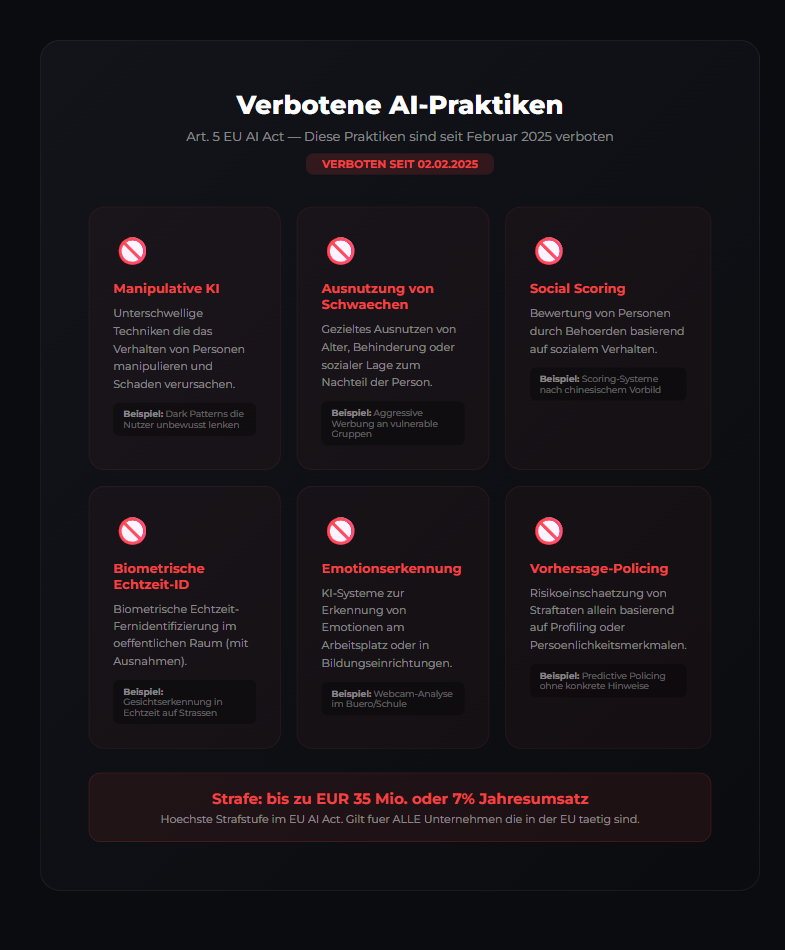
The 6 Prohibited Practices
1. Subversive Manipulation (Art. 5(1)(a))
What is prohibited: AI systems that lead people to harmful decisions through "subliminal techniques" or deliberate deception.
Example: An AI tool that manipulates impulsive purchasing behavior through hidden triggers.
2. Social Scoring (Art. 5(1)(b))
What is prohibited: AI systems that evaluate persons based on their social behavior or non-legally justified criteria.
Example: A system that assesses creditworthiness based on social media activity.
3. Biometric Categorization (Art. 5(1)(c))
What is prohibited: Use of biometric data to categorize persons in real-time at public places.
Example: Real-time facial recognition in public places to detect "suspicious behavior".
4. Emotion Recognition in Workplace (Art. 5(1)(d))
What is prohibited: AI systems for emotion recognition in the workplace and educational institutions.
Example: Webcam analysis during job interviews to assess "trustworthiness" or "nervousness".
5. Untargeted Facial Data Collection (Art. 5(1)(e))
What is prohibited: Creating or expanding databases through untargeted collection of facial images from the internet.
Example: Scraping social media profiles to create face recognition databases.
6. Government Social Scoring Systems (Art. 5(1)(f))
What is prohibited: AI systems by government agencies that score citizens based on social behavior.
Example: Automated decisions about social benefits based on "risk scores".
Exceptions
Certain biometric applications are allowed:
- Facial recognition for law enforcement (with authorization)
- Emergency searches (missing persons, terrorism)
- Medical applications
- Critical infrastructure security
What Companies Must Do Now
- Check all AI systems for prohibited practices
- Update documentation of existing systems
- Review contracts with AI providers
- Create internal guidelines for permitted AI use
Sources
Related articles: EU AI Act · EU AI Act Checklist
For implementation support, find resources at ai-engineering.at.
Related articles
EU AI Act
Risk classes, prohibitions, transparency requirements for AI systems in the EU.
Chatbot Transparency Obligations under EU AI Act
What you need to know about chatbots and AI-generated content. Labeling requirements, disclosure, copyright — all in one place.
EU AI Act Compliance Checklist
Your 7-step guide to EU AI Act readiness. Risk classes, transparency requirements, prohibitions - everything compact.
Was this article helpful?
Continue the learning path
The learning path puts these articles in order, and the Hub carries the building blocks we have checked in our own operations.
- Local and self-hosted
- Documented and verifiable
- From our own operations
- Made in Austria