AI Literacy under Art. 4 EU AI Act
Compliance · 12 min · Updated: March 2026
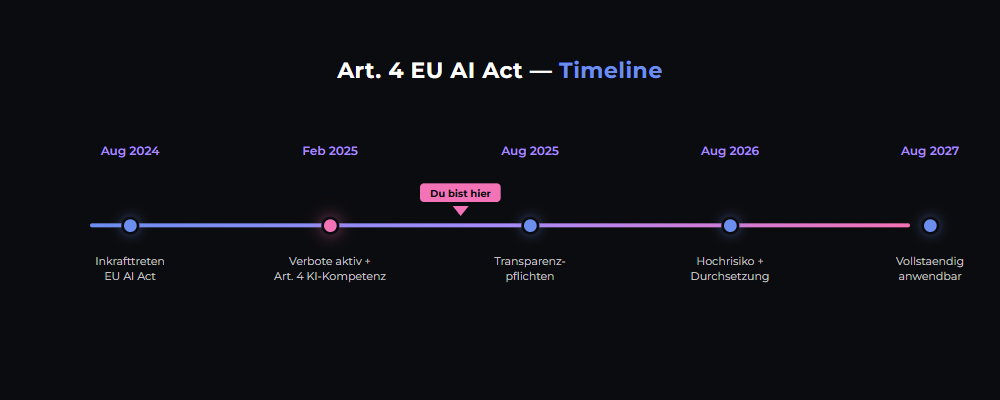
ATTENTION: Art. 4 AI Literacy applies since 2 February 2025! The AI literacy obligation is not a future deadline — it is already in force. Companies using AI systems must now ensure that their staff has sufficient AI literacy. There is no single certification, no mandatory AI Officer role, and no one-size-fits-all training requirement. Enforcement with penalties up to EUR 15 million or 3% of global annual turnover starts from August 2026.
What is Art. 4?
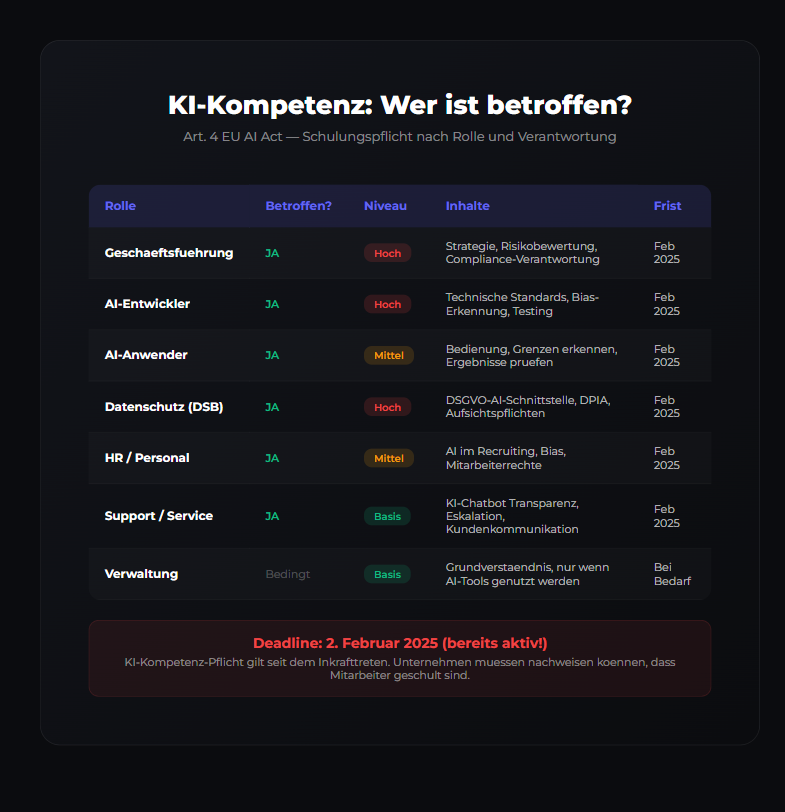
Article 4 of the EU AI Act (Regulation (EU) 2024/1689) requires all providers and deployers of AI systems to ensure that their staff has a sufficient level of AI literacy. This applies regardless of the risk class of the AI system — including minimal-risk applications like chatbots or recommendation engines.
Who is affected?
| Role | Examples | Affected? |
|---|---|---|
| AI Providers | Software vendors, SaaS with AI features | Yes |
| AI Deployers | Any company using AI tools | Yes |
| Staff | All employees operating or working with AI | Yes |
| End users (private) | Personal ChatGPT use | No |
In Austria alone, an estimated 400,000 companies are affected — every SME using ChatGPT, Copilot, AI-powered accounting or any other AI tool. The same applies to all companies in the EU/EEA.
What must be trained?
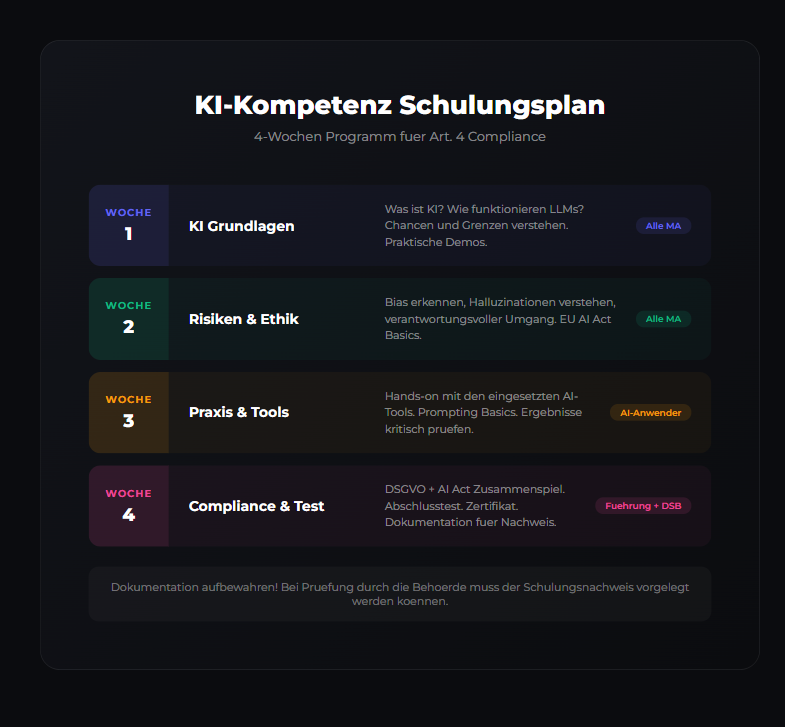
1. AI Fundamentals
- What AI is, what it can do, what it cannot
- Difference between rule-based systems and machine learning
- Key concepts: model, training, inference, hallucination
2. Risks and Limitations
- Bias and discrimination in AI outputs
- Hallucinations and incorrect outputs
- Privacy risks with cloud AI (third-country transfers)
- Manipulation risks (prompt injection)
3. Legal Framework
- EU AI Act risk classes (Prohibited, High, Limited, Minimal)
- Transparency requirements (labeling AI-generated content)
- GDPR requirements for AI usage
- Documentation obligations
4. Practical Application
- Responsible use of AI tools in daily work
- When to verify AI results, when to trust them
- Reporting obligations for malfunctions
- Ensuring human oversight
Penalties
| Violation | Penalty |
|---|---|
| Prohibited AI practices (Art. 5) | Up to EUR 35M or 7% revenue |
| Non-compliance with Art. 4 (AI literacy) | Up to EUR 15M or 3% revenue |
| False information to authorities | Up to EUR 7.5M or 1% revenue |
For SMEs and startups, proportionate caps apply — whichever amount is lower.
Checklist: Implementing AI Literacy
- 1. Create inventory: Which AI systems does your company use?
- 2. Identify affected staff: Who works with AI?
- 3. Assess training needs: What competency level is required (based on role and risk class)?
- 4. Conduct training: Fundamentals, risks, legal framework, practical application
- 5. Document everything: Keep training records (who, when, what)
- 6. Repeat regularly: AI evolves fast — update training annually
Further Reading
Sources
Related articles
EU AI Act
Risk classes, prohibitions, transparency requirements for AI systems in the EU.
EU AI Act Compliance Checklist
Your 7-step guide to EU AI Act readiness. Risk classes, transparency requirements, prohibitions - everything compact.
AI in the Enterprise
Why companies use local AI: data privacy (GDPR), cost control, and operational sovereignty.
Was this article helpful?
Continue the learning path
The learning path puts these articles in order, and the Hub carries the building blocks we have checked in our own operations.
- Local and self-hosted
- Documented and verifiable
- From our own operations
- Made in Austria