EU AI Act
Compliance · 6 min
The EU AI Act (Regulation 2024/1689) was published on 12 July 2024 and entered into force on 1 August 2024. It is the world's first comprehensive AI regulation. Some obligations — such as the prohibitions (Art. 5) and AI literacy (Art. 4) — have been applicable since 2 February 2025. Full application with enforcement and penalties starts from 2 August 2026.
The AI literacy obligation (Art. 4) has been in force since 2 February 2025. There is no single certification, no mandatory AI Officer role, and no one-size-fits-all training requirement. Enforcement and supervision starts from August 2026.

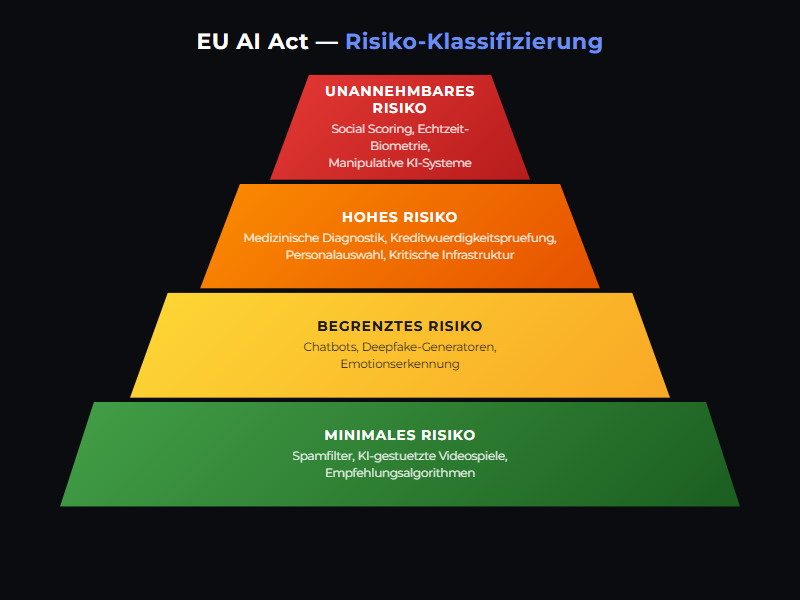
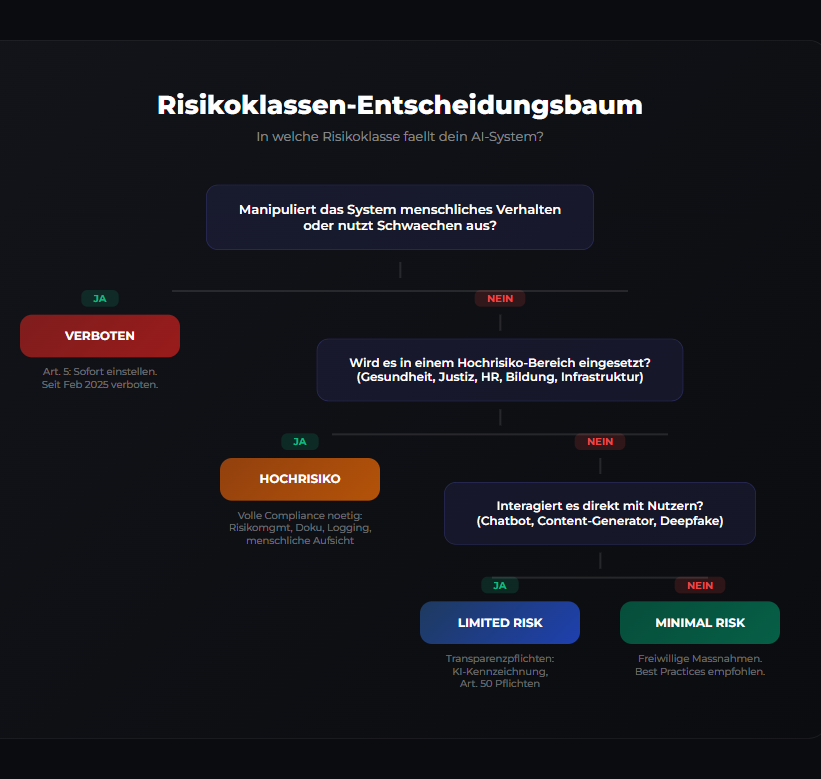
Risk Classes
| Class | Examples | Requirements |
|---|---|---|
| Unacceptable | Social scoring, manipulation | BANNED |
| High | HR, credit, biometric | Full compliance |
| Limited | Chatbots, deepfakes | Transparency |
| Minimal | Spam filters | None |
Typical Business AI Scenarios
| Scenario | Risk Level | Obligations |
|---|---|---|
| LLM for content creation | Minimal to Limited | Transparency when publishing without human review |
| AI customer support chatbot | Limited | Users must know they are talking to AI. If it makes service decisions, may be high-risk. |
| Internal productivity (email, code, summaries) | Minimal | No specific obligations, but documentation recommended |
| AI for recruiting (CV screening, candidate ranking) | High | Full compliance: documentation, risk management, human oversight |
High-Risk Requirements Detail
- Risk management system: Documented, ongoing process to identify, analyze, and mitigate risks — not a one-time assessment
- Data governance: Training and test data must meet quality criteria. Document data sources, preparation methods, and potential biases
- Technical documentation: Detailed documentation before market placement including intended purpose, design methodology, and test results
- Record-keeping: Automatic logging of AI system operations for traceability. Provide to authorities on request
- Transparency: Clear information about capabilities, limitations, and intended use
- Human oversight: Humans can understand capabilities and limits, intervene in decisions, and choose not to use the system
Timeline
- 12 Jul 2024: Published in EU Official Journal
- 1 Aug 2024: Entered into force
- 2 Feb 2025: Prohibitions (Art. 5) + AI Literacy (Art. 4) ALREADY APPLY
- 2 Aug 2025: Governance rules + GPAI models
- 2 Aug 2026: Full application (high-risk etc.) + enforcement/supervision starts
- 2 Aug 2027: High-risk AI in regulated products
Penalties
- Unacceptable risk: EUR 35M or 7% global revenue
- Non-compliance: EUR 15M or 3% global revenue
- Incorrect information: EUR 7.5M or 1% global revenue
What Local AI Helps With
- No third-country transfer
- Full documentation possible
- Transparency easier to implement
- Data stays in EU
Sources
Related articles
EU AI Act Compliance Checklist
Your 7-step guide to EU AI Act readiness. Risk classes, transparency requirements, prohibitions - everything compact.
Prohibited AI Practices under EU AI Act
Article 5 prohibits certain AI practices. Social Scoring, Emotion Recognition, Biometric Surveillance - what has been forbidden since Feb 2025.
AI Literacy under Art. 4 EU AI Act
Art. 4 EU AI Act: AI literacy obligation applies since Feb 2, 2025. Enforcement from Aug 2026, penalties up to EUR 15M. Practical guide for SMEs.
Was this article helpful?
Continue the learning path
The learning path puts these articles in order, and the Hub carries the building blocks we have checked in our own operations.
- Local and self-hosted
- Documented and verifiable
- From our own operations
- Made in Austria