Safety Hooks Pattern
Patterns · 5 min
The Problem
You cant manually check every API call. But you need to ensure no harmful outputs, data leaks, or unintended actions happen.
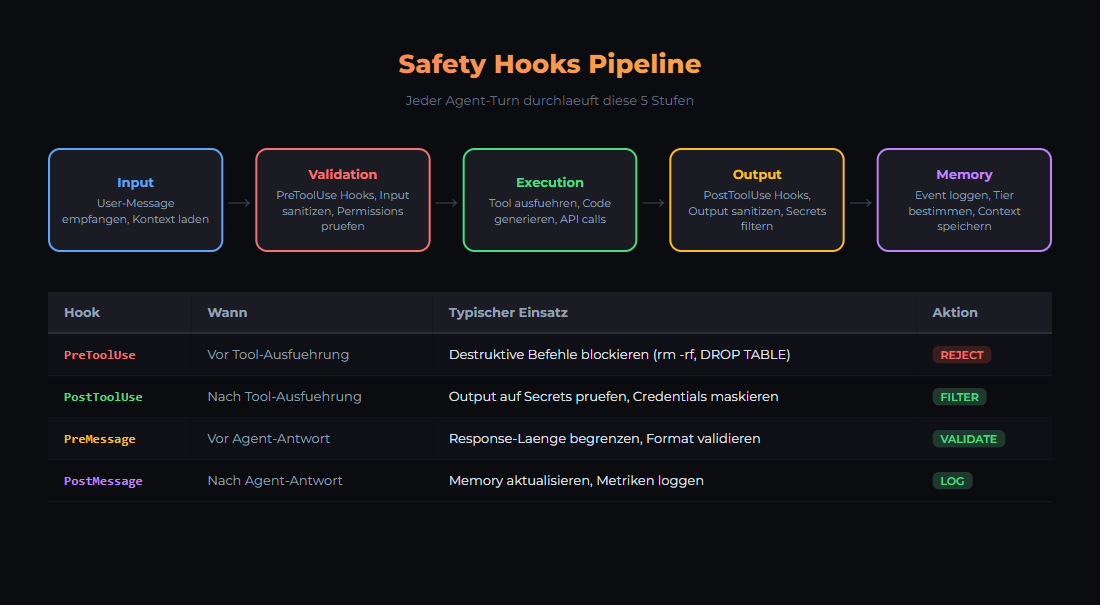
Solution: Safety Hooks
Hooks are automatic checks that run on every call.
User Input
     |
     v
[Input Validation Hook]
     |         |
     |        (Block if invalid)
     v
[Agent Execution]
     |
     v
[Output Filter Hook]
     |         |
     |        (Block/modify if unsafe)
     v
[Memory Capture Hook]
     |         |
     +----> Save to persistent storage
     |
     v
User Response
Types of Hooks
1. Input Validation Hook
- Check for forbidden words
- Validate JSON/syntax
- Check rate limits
2. Output Filter Hook
- Remove PII (Personally Identifiable Information)
- Block sensitive data (API keys, passwords)
- Format output by schema
3. Memory Capture Hook
- Save every successful call
- Log errors for debugging
- Enable future learning from past
Implementation in n8n
// n8n Function Node - Input Hook
const forbidden = ['hack', 'exploit', 'bypass'];
const input = $input.item.json.message;

for (const word of forbidden) {
  if (input.toLowerCase().includes(word)) {
    throw new Error('Input blocked by safety hook');
  }
}

return $input.item;
Best Practices
- Don't silently ignore hook errors
- Enable logging for audit trail
- Regularly update safety rules
- Reduce false positives with whitelists
Sources
Related articles
Patterns
Agent Orchestration Patterns
Proven orchestration patterns for Multi-Agent Systems: sequential, parallel, hierarchical, router, and supervisor.
Security
API Keys Secure Storage
Vault, Environment Variables, Secrets Management for AI Stack.
Patterns
Heartbeat & Monitoring
How to know if agents are running. Health checks, status updates, alerting.
Was this article helpful?
Continue the learning path
The learning path puts these articles in order, and the Hub carries the building blocks we have checked in our own operations.
Why AI Engineering
- Local and self-hosted
- Documented and verifiable
- From our own operations
- Made in Austria
Not legal advice.