What is Agent Orchestration?
Basics · 5 min
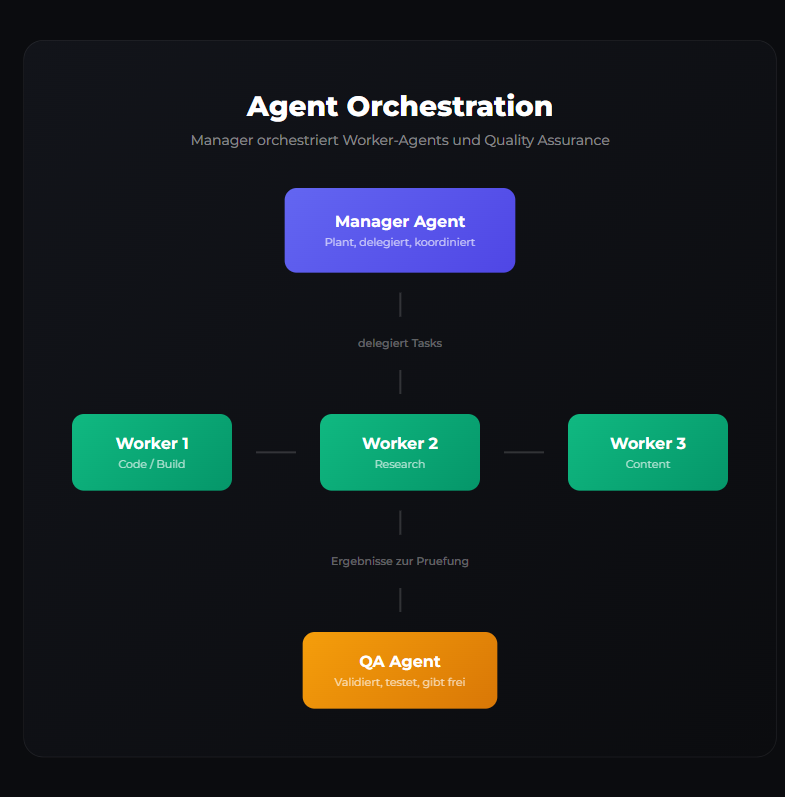
Agent Orchestration coordinates multiple AI agents that work together on complex tasks. Instead of a single chat, you run a team of specialized agents with clear responsibilities.
The problem with a single LLM
A single Large Language Model (LLM) like ChatGPT can handle plenty of tasks, but it has real limits:
- No persistent memory between sessions
- Can't execute code changes on its own
- No access to your infrastructure
- Works in isolation — no teamwork possible
The solution: Multi-Agent System
With agent orchestration, you create multiple specialized agents, each with a specific role:
Example: Agent Team
| Agent | Role |
|---|---|
| Manager-Agent | Manager — prioritization, approvals |
| Developer-Agent | Frontend/App/CI — Next.js, tests |
| Infrastructure-Agent | Backend/Infra — n8n, Docker, monitoring |
| QA-Agent | QA/Content — testing, research |
Communication
Agents communicate through a central bus. We use Team-Chat for this. Each agent has its own polling scripts that respond to messages relevant to them.
Communication flow
1. Joe posts task in #echo_log
    ↓
2. Manager-Agent (Manager) prioritizes and delegates
    ↓
3. Developer-Agent → writes code
   Infrastructure-Agent → prepares infrastructure
   QA-Agent → checks content
    ↓
4. All post results back
    ↓
5. Manager-Agent aggregates and reports completion
Benefits
- Parallelization: Run multiple agents at the same time
- Specialization: Each agent is an expert in their domain
- Scalability: Adding a new agent is straightforward
- Auditability: Every action gets logged to Team-Chat
- GDPR: Everything stays local — no prompt training on your data
Tech Stack
Our setup uses:
- Team-Chat — Team chat as the message bus
- n8n — Workflow automation
- Docker Swarm — Container orchestration
- Claude Code — CLI access to LLM capabilities
- Prometheus + Grafana — Monitoring
Next steps
Want to learn more about Multi-Agent Systems? Continue to: Multi-Agent Systems Explained →
Related articles
Multi-Agent Systems Explained
How multiple AI agents work together, how they communicate, and why it beats a single LLM.
Agent Orchestration Patterns
Proven orchestration patterns for Multi-Agent Systems: sequential, parallel, hierarchical, router, and supervisor.
Build an AI Agent Team
How to build an AI agent team: agent types, roles, tool integration and guardrails. Designed for GDPR-compliant, self-hosted setups.
Was this article helpful?
Continue the learning path
The learning path puts these articles in order, and the Hub carries the building blocks we have checked in our own operations.
- Local and self-hosted
- Documented and verifiable
- From our own operations
- Made in Austria