Task Delegation Pattern
Patterns · 5 min
The Problem
A single agent can't do everything better than specialized tools. You need a system that selects the right agent for the right task.
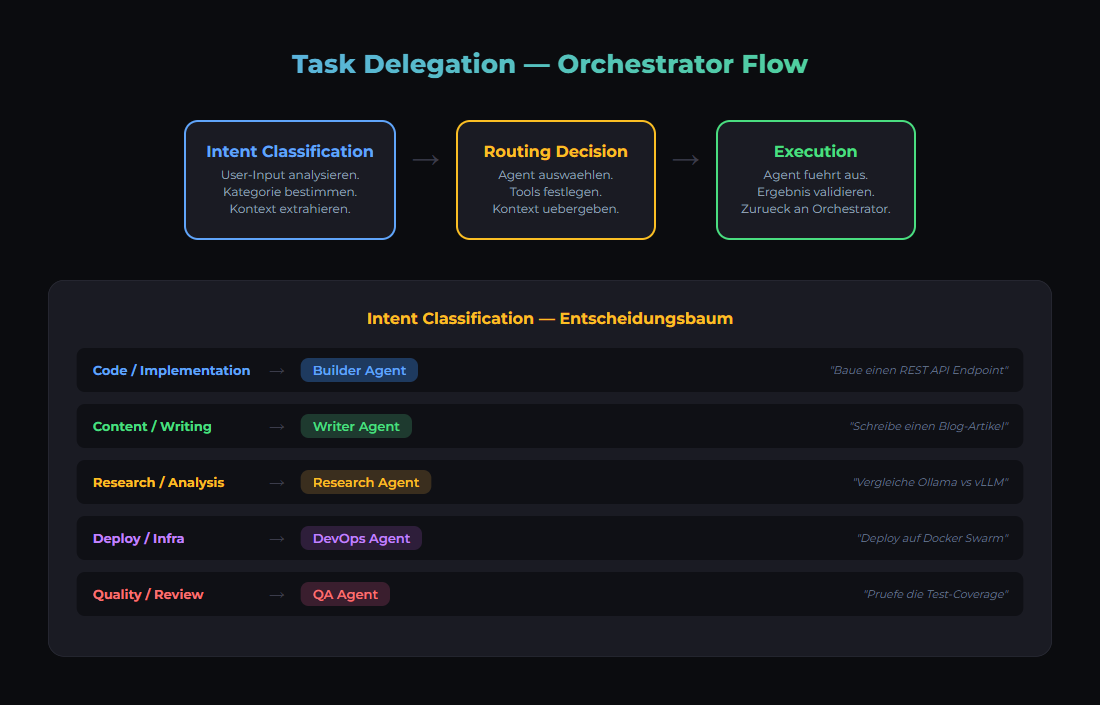
Architecture
User Request
     |
     v
[Orchestrator Agent]
     |
     +---> [Research Agent] ----> Web Search, Docs
     |
     +---> [Coder Agent] ----> Code Generation
     |
     +---> [Review Agent] ----> PR Review, Tests
     |
     v
  Final Response
Implementation
1. Intent Classification
The Orchestrator classifies the user request and routes it to the appropriate agent.
2. Routing Matrix
const routes = {
  'code-generation': coderAgent,
  'research': researchAgent,
  'review': reviewAgent,
  'deployment': deployAgent,
  'question': qaAgent,
}
3. Priority Queue
For multiple concurrent tasks: Set priorities (1 = highest). Deadline tracking prevents tasks from waiting forever.
4. Result Aggregation
The Orchestrator collects results from all sub-agents and synthesizes a final response.
Important Aspects
- Timeout: Each sub-agent needs a max timeout
- Retry: Max 2x on errors
- Fallback: What if all agents fail?
- Cost Control: Budget limits per task
Sources
Related articles
Agent Orchestration Patterns
Proven orchestration patterns for Multi-Agent Systems: sequential, parallel, hierarchical, router, and supervisor.
Agent Roles & Responsibilities
Role model for Multi-Agent Systems: orchestrator, workers, QA/review and infra. Clear ownership, boundaries and escalation paths in practice.
Build an AI Agent Team
How to build an AI agent team: agent types, roles, tool integration and guardrails. Designed for GDPR-compliant, self-hosted setups.
Was this article helpful?
Continue the learning path
The learning path puts these articles in order, and the Hub carries the building blocks we have checked in our own operations.
- Local and self-hosted
- Documented and verifiable
- From our own operations
- Made in Austria